
Bonding & lamination for displays, touchscreens, cover glass and films
Optimized bonding technologies such as optical bonding(OCA bonding and LOCA bonding) and air gap bonding improve the image quality, robustness and service life of your HMI and display modules — from industrial to medical technology and outdoor.
Maximum readability, shockproof — ideal for outdoor & industry — Made in Germany or Asia
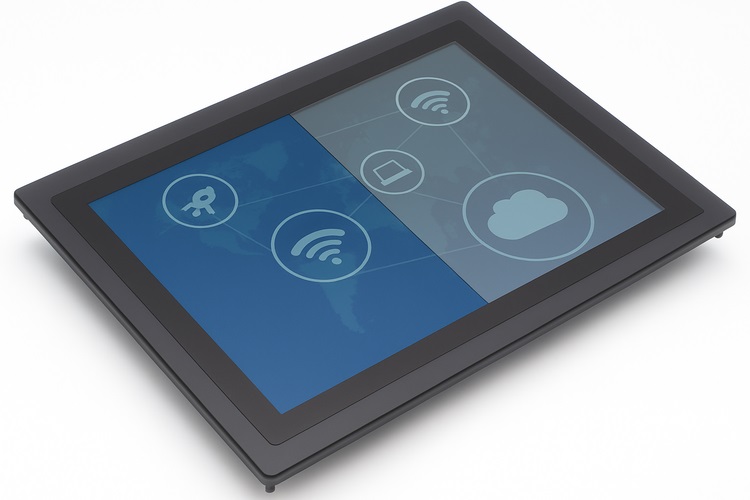
Full optical bonding — What is optical bonding?
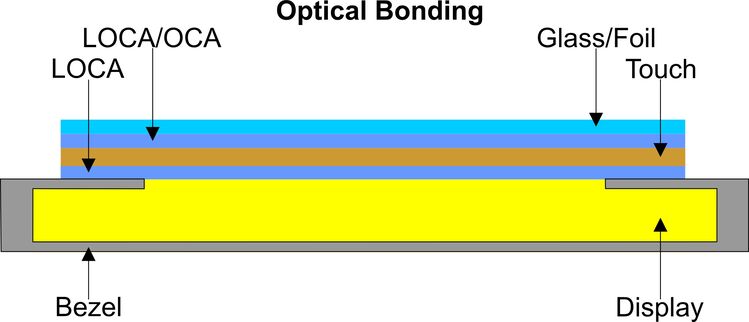
With optical bonding, the cover glass, touch and display are bonded together over the entire surface without an air gap. A transparent adhesive is applied between the glass and the display — usually OCA (Optically Clear Adhesive) or LOCA (Liquid Optically Clear Adhesive) — is applied between the glass and the display. The result is better readability in sunlight, fewer reflections and higher contrast. Optical bonding also increases the robustness of the display, as the composite is more resistant to shocks, vibrations and moisture.
Advantages of optical bonding
Robustness and mechanical stability
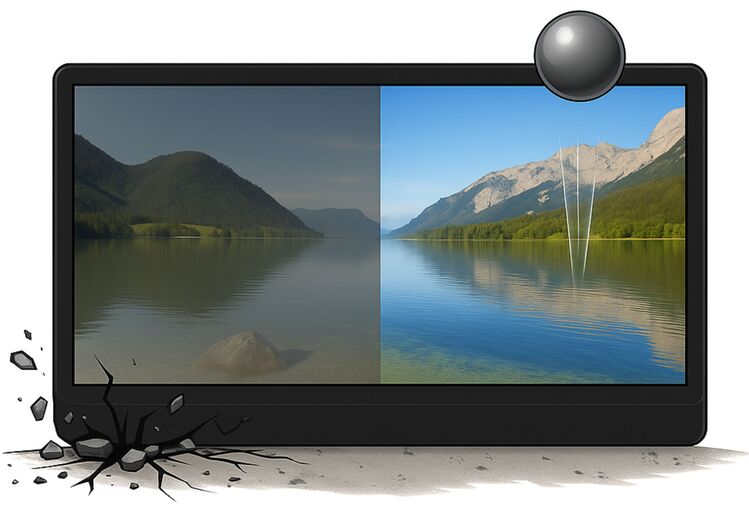
Very high robustness and impact resistance, ideally protected for outdoor environments and against vandalism. Mechanical stability at its best!
Reflection reduction and brightness
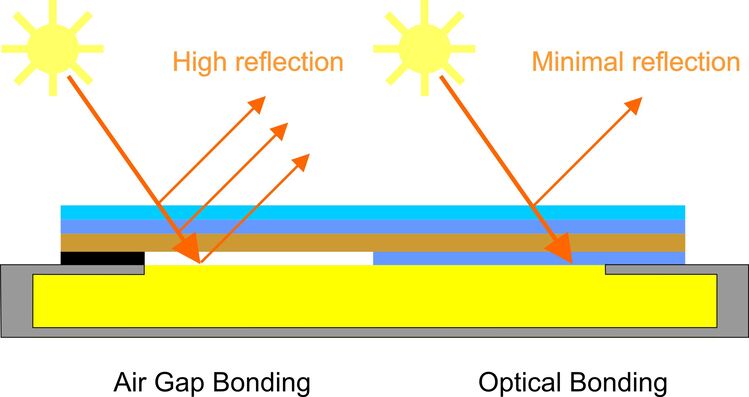
Significantly reduced reflections and improved readability thanks to the elimination of the air gap as well as increased brightness and contrast stability, even in direct sunlight, for consistently optimum display performance.
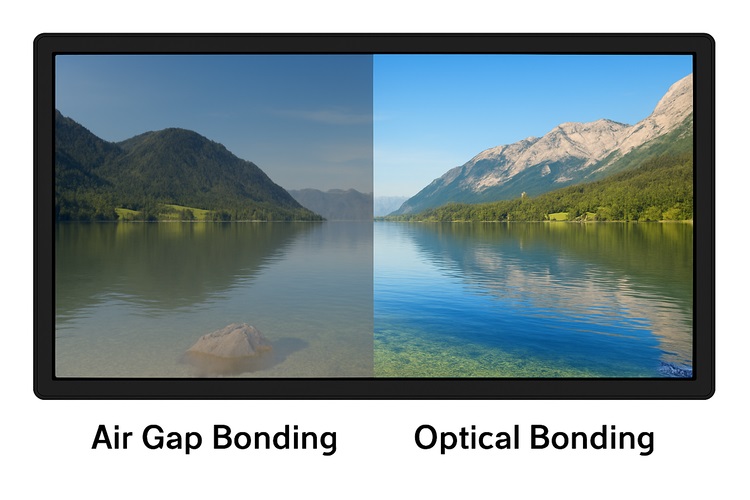
Cost-efficient alternative — What is air gap bonding (lamination)?
With air gap bonding, the cover glass is attached to the touch or display with double-sided adhesive tape without completely filling the air gap. This creates a narrow air gap between the glass and the display, which is sufficient for many indoor applications. Compared to optical bonding, however, reflections, reduced robustness and condensation can occur in the event of large temperature differences. This construction method is cheaper and easier to implement than optical bonding, as no additional adhesive is required. We can advise you on whether air gap bonding makes sense for your project — or whether optical bonding offers clear advantages.
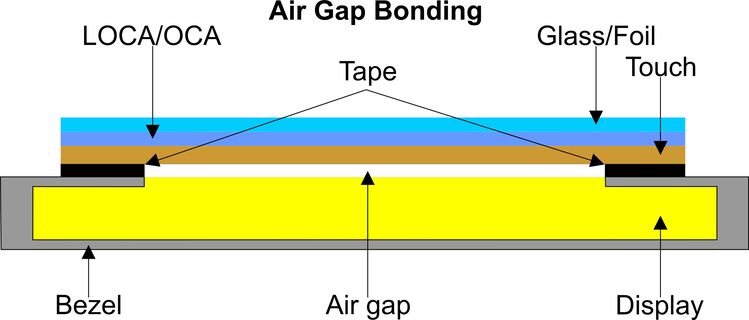
Advantages of air gap bonding
Lower production costs
Cost-efficient alternative to full optical bonding — optical bonding
Easier and faster production
The process is less complex and therefore has a higher yield
Better repairability
As the layers are not fully bonded, the glass or touch panel can be replaced more easily
Selection of technology
|
Description / Design |
Air-Gap (Double-sided spacer tape) |
Dry — DOCA (PVB, OCA,…) |
Wet — LOCA (silicone or acrylate-based) |
|
Typical transmission optical bonding layer (without component transmission*) |
88% |
95%*** |
95%*** |
|
Max. Temperature range (limitation rather by components) |
-30° to +80°C |
-30° to +80°C |
-30° to +80°C |
|
Protection against condensation between layers |
No |
Yes |
Yes |
|
EMC protection or other functions (polarization foils etc.) |
Only via components |
Via components or additional layers |
Via components or additional layers |
|
Combination rigid with flexible** |
No |
Yes |
Conditional |
|
Combination of rigid with rigid |
Yes |
No |
Yes |
|
Combination Flexible with Flexible |
Conditional |
Yes |
No |
|
Bonding uneven surfaces |
Conditional |
No |
Yes, (topping up possible) |
|
Installation height |
Up to 1mm |
Up to 0.3mm |
Up to 1mm |
|
Cost efficiency |
Very high |
Medium |
Medium to high |
*Theoverall transmission depends largely on the components used. Additional anti-reflective properties can therefore be achieved via the components or additional layers.
**e.g. films or thin PMMA/PC
***BenefitTransmission: Display must produce 7–8% less brightness to give the same impression to the user
Our recommendation: Optical bonding for demanding outdoor and industrial applications & air gap bonding for cost-conscious indoor projects.
Terms & synonyms
Full-surface bonding, Direct display bonding, Optically clear bonding, Laminated display unit, Display lamination, Air gap bonding, Air gap display, Classic display mounting, Indirect bonding
Manufacturing process
As an experienced display and HMI partner, we manufacture optical bonding and air gap bonding in a controlled environment and with high quality standards.
The process includes the selection of the appropriate adhesive(OCA or LOCA), material preparation & cleaning, precise alignment, lamination, degassing, curing and final optical and functional testing.
Frequently asked questions about bonding & lamination
Project request
Briefly describe your project — we will get back to you with advice and a proposal.
- Industry & operating environment
- Displaydiagonale
- Outdoor or indoor
Related components
EP Electronic Print GmbH
Your partner for customized HMI solutions, optical bonding, front foils and membrane keypads.
Contact us
Phone: +49 (0)8142 /420896–0
E‑mail: info@ep-electronicprint.de